Startseite - Home

Katalog
Catalogue

eBooks

Verlage
Publishers

Startseite :: Home
Kontakt :: Contact
Über uns :: About us
Datenschutz :: Privacy Policy
Impressum :: Imprint
Kundeninformation

Cambridge Histories Online (CHO):
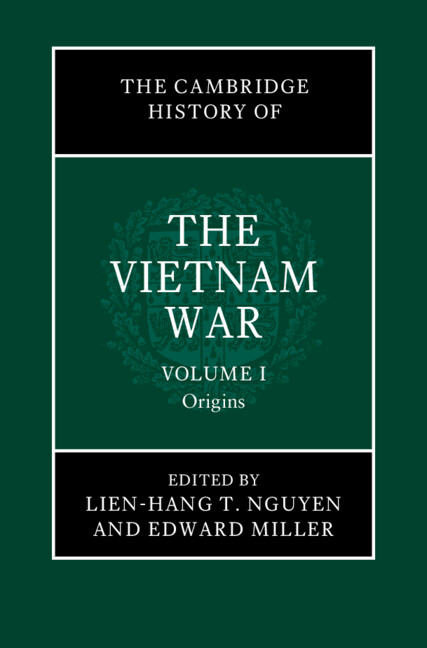
The Cambridge History of the Vietnam War

Kontakt/Bestellung
Contact/Order:

Contact/Order: info@digento.de

Volume 1: Origins
Volume 2: Escalation and Stalemate
Volume 3: Endings and Aftermaths

Hrsg. v. Lien-Hang T. Nguyen

Online

Verlag :: Publisher

Cambridge University Press

Cambridge Histories Online (CHO)


Cambridge Histories Online (CHO): The Cambridge History of the Vietnam War

Preis :: Price

Preise auf Anfrage / Prices on request


Siehe auch:
Cambridge Histories Online (CHO)

Das Angebot richtet sich nicht an Verbraucher i. S. d. § 13 BGB und Letztverbraucher i. S. d. PAngV.

ISBN/ISSN

978-1-316-22524-0 (Volume 1)
978-1-316-22526-4 (Volume 2)
978-1-316-22528-8 (Volume 3)

Bestellnummer bei digento :: digento order number

10603319

Verlagsinformation :: Publisher's information

Volume 1: Origins
General editor Lien-Hang T. Nguyen, Columbia University, New York
Edited by Edward Miller, Dartmouth College, New Hampshire


When, how, and why did the Vietnam War begin? Although ist end is dated April 30, 1975, there is no agreement as to when it began. The Vietnam War was an enormously complex conflict and while any comprehensive reckoning must include the role of the US, it was not an 'American War'. This volume presents the scholarship that has flourished since the 1990s to situate the war and ist origins within longer chronologies and larger interpretative perspectives. The Vietnam War was a war for national liberation and an episode of major importance in the global Cold War. Yet it was also a civil war, and civil warfare was a defining feature from the outset. Understanding the Vietnamese and Indochinese origins of the Vietnam War is a critical first step toward reckoning with the history of this violent, costly, and complex war.

Volume 2: Escalation and Stalemate

General editor Lien-Hang T. Nguyen, Columbia University, New York
Edited by Andrew Preston, University of Cambridge

In great depth, Volume II examines the escalation of the Vietnam War and ist development into a violent stalemate, beginning with the overthrow of the Ngô Đình Diệm in 1963 to the aftermath of the 1968 Tết Offensive. This five-year period was, for the most part, the fulcrum of a three-decades-long struggle to determine the future of Vietnam and was marked by rival spirals of escalation generated by the Democratic Republic of Vietnam and the United States. The volume explores the war's military aspects on all sides, the politics of war in the two Vietnams and the United States, and the war's international and transnational dimensions in politics, protest, diplomacy, and economics, while also paying close attention to the agency of historical actors on both sides of the conflict in South Vietnam.

Volume 3: Endings and Aftermaths

General editor Lien-Hang T. Nguyen, Columbia University, New York
Edited by Pierre Asselin, San Diego State Universit


The third and final volume of The Cambridge History of the Vietnam War examines key domestic, regional, and international developments in the period before and after the war's end, including its legal, environmental, and memorial legacies. The latter stages of the Vietnam War witnessed its apex as a Cold War crucible. The Sino-Soviet dispute, Sino-American rapprochement, Soviet-American détente, and global counter-culturalism served in various ways to elevate the already high profile and importance of the conflict, as did its expansion into Cambodia and Laos. After the “fall” of Saigon to communist-led forces and Vietnam's formal reunification in 1975-76, Hanoi's persecution of former enemies, discrimination against ethnic Chinese, and economic mismanagement triggered a massive migratory crisis that redefined international refugee policies. In time, the migration changed the demographic landscape of cities across North America and Europe and continued to impact our world long after the conflict ended.y

Nach oben