|
|
|||
The British Union of Fascists: Newspapers and Secret Files, 1933–1951 |
Kontakt/Bestellung
Contact/Order: info@digento.de 
|
|
Online |
|
|
Verlag :: Publisher Microform Academic Publishers |
|
|
Preis :: Price Preise auf Anfrage / Prices on request |
|
|
Das Angebot richtet sich nicht an Verbraucher i. S. d. § 13 BGB und Letztverbraucher i. S. d. PAngV. |
|
|
ISBN/ISSN 978-1-85117-373-0 Bestellnummer bei digento :: digento order number 10735108 |
|
|
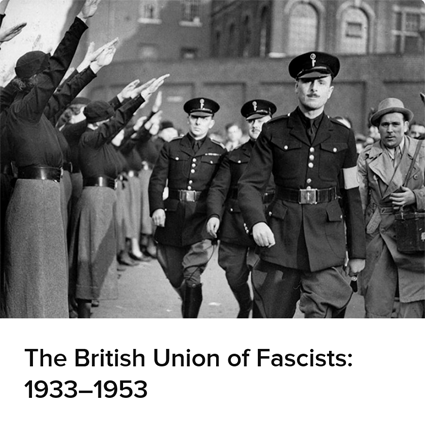
Verlagsinformation :: Publisher's information Though most often associated with the regimes of Adolf Hitler and Benito Mussolini in Germany and Italy, fascism was also a feature of the British political landscape during the 1930s and 1940s. Founded in 1932 by former Conservative and Labour MP Oswald Mosley, the British Union of Fascists (BUF) initially garnered considerable support, including from popular periodicals such as the Daily Mail. The party and its supporters – known as “blackshirts” – drew on racist British imperial discourse and mirrored the antisemitic attitudes of its German and Italian counterparts. The party frequently engaged in violent confrontations with anti-fascist groups, culminating in the Battle of Cable Street in London’s East End, in October 1936. Featuring nearly 8,000 images, this collection contains a wealth of material charting the political trajectory of Mosley and the BUF between 1933 and 1953. It holds a cross section of personal papers from key members of the British fascist movement, such as Nazi propagandist William Joyce (commonly known as “Lord Haw Haw”). The collection also includes documents from various UK government departments which, throughout the 1930s and 1940s, sought to temper the influence of the BUF leader and his supporters. This includes documents detailing MI5’s surveillance of Mosley and his wife Diana Mosley (née Mitford), which led to their eventual internment in 1940 after the Battle of France.
|
|